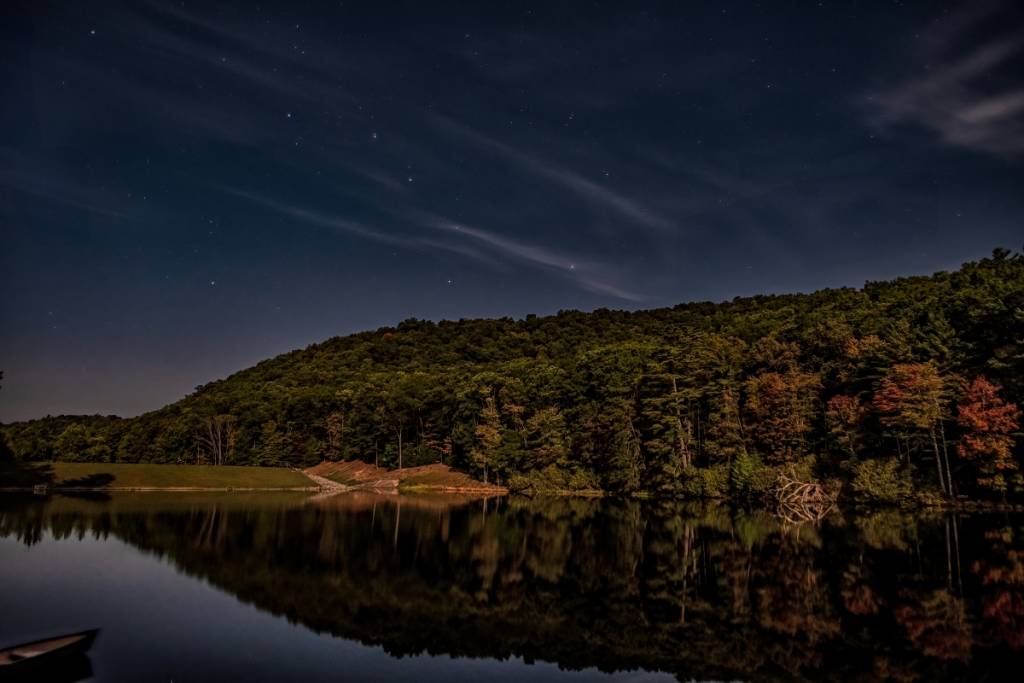

There is a place in West Virginia where your phone may stop working long before you reach your campsite, making it one of the most unusual places to plan an unplugged fall getaway from Washington, D.C.
The National Radio Quiet Zone (NRQZ) stretches across roughly 13,000 square miles of West Virginia and Virginia, protecting sensitive radio astronomy equipment from radio-frequency interference.
For campers, however, the result is an entirely different kind of escape: fewer signals, fewer distractions and exceptionally dark nighttime skies in one of the most remote corners of the region.
And with peak fall foliage, mountain scenery and campgrounds such as Watoga State Park, this could be one of the most memorable ways to disconnect this autumn.
What and where is the National Radio Quiet Zone?
The National Radio Quiet Zone is a 13,000-square-mile region centered between Green Bank and Sugar Grove, West Virginia, established by the Federal Communications Commission in 1958 to minimize radio interference affecting scientific research and other federal facilities.
At the heart of the zone is the Green Bank Observatory, home to the Green Bank Telescope, where radio astronomers study extremely faint signals from the universe.
The NRQZ is not simply a place where cell phones are prohibited, but the restrictions on radio transmissions — combined with the region’s mountainous terrain and relatively low population density — have helped preserve an unusually quiet radio environment.
For visitors around Green Bank, cell service can be nonexistent, and the observatory itself asks visitors to disable wireless signals from phones and other smart devices while on its grounds.
That makes this corner of West Virginia particularly appealing for anyone who wants to spend a weekend where checking notifications, answering emails and endlessly scrolling simply isn’t an option.
What to expect if you go
If you’re planning to camp inside or near the NRQZ, prepare for an actual disconnect rather than simply choosing to put your phone on airplane mode. The Green Bank Observatory specifically recommends downloading maps ahead of time, printing directions and/or bringing a paper map because visitors should not rely solely on a mobile device for navigation.
That means downloading everything you’ll want before leaving civilization:
- Offline maps and directions
- Music, podcasts and audiobooks
- Movies or shows for downtime
- Camping reservations and confirmation information
- Any important travel information you’ll need
One particularly appealing base for the trip is Watoga State Park, West Virginia’s largest state park, encompassing 10,100 acres in Pocahontas County. The park has two campgrounds and 88 campsites, with 38 sites at Beaver Creek Campground and 50 at Riverside Campground; both campgrounds have 50-amp electric hookups, along with bathhouse and laundry facilities.
Watoga also has more than 40 miles of hiking trails, an 11-acre lake, boating, fishing and biking, so the lack of connectivity doesn’t mean you’ll run out of things to do.
And when the sun goes down, the experience changes completely: Pocahontas County has minimal light pollution and three International Dark Sky-designated public areas, including Watoga State Park.
When is the best time to go?
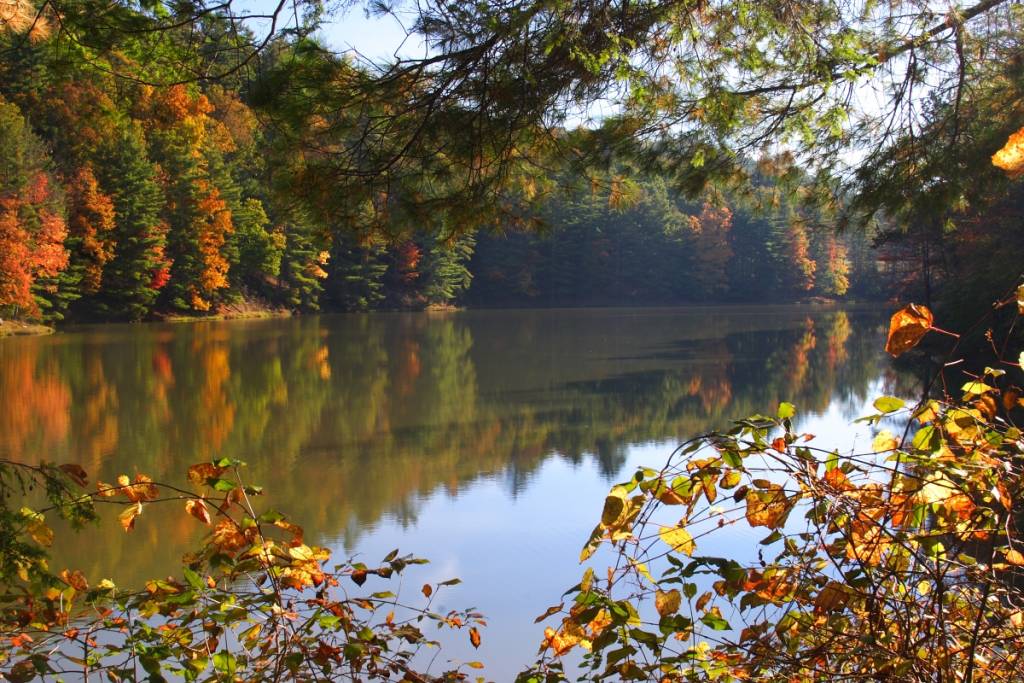
Mid-fall is arguably the best time to plan this trip, when the surrounding Appalachian forests begin putting on their annual display of reds, oranges and yellows.
The combination of colorful mountain scenery during the day and dark, star-filled skies after sunset makes the region especially appealing for an autumn camping weekend.
Watoga’s campgrounds are open spring through fall, weather permitting, so fall visitors should check current campground conditions before making the drive.
The cooler temperatures also make it a particularly good season for hiking, sitting around a campfire and spending the evening outside without the heat and humidity of summer.
For the full experience, plan to arrive with your maps and entertainment already downloaded, leave the constant connectivity behind and let the mountains, fall foliage and night sky become the weekend’s entertainment.